


Gallarus Oratory
Walking in the Footsteps of Saints: Ireland’s Pilgrim Paths
Long before the Camino de Santiago drew modern walkers to Spain, Ireland had its own dense network of pilgrim routes paths worn down by monks, scholars and penitents making their way to monastic settlements scattered across the island. Many of these routes predate the continental Camino by centuries, tracing journeys to early Christian saints whose names still mark the landscape: Kevin, Brendan, Finbarr, Colmcille. Several are now officially recognised by the Camino Society Ireland and formally linked to the wider European Camino network, letting today’s walkers collect pilgrim stamps just as they would in France or Spain.
What makes Ireland’s pilgrim paths distinctive is how naturally they sit inside the country’s better-known long-distance trails. You don’t need a dedicated “pilgrimage holiday” to walk in the footsteps of these early saints on several of Hillwalk Tours’ most popular routes, the pilgrim path is the trail, or runs alongside it as an optional detour.
The Kerry Camino
The Camino de Santiago (the Way of St. James) is a vast network of ancient pilgrim routes stretching across Europe, finishing at the tomb of St. James in Santiago de Compostela. The 57km Kerry Camino is part of this network and an official pilgrim route listed by the Camino Society Ireland, starting at St. John’s Church in Tralee and believed to have been walked by pilgrims on their way to St. James’ Church in Dingle a church originally built by Spanish merchants and dedicated to St. James of Santiago de Compostela, making Dingle a famous departure point for Irish pilgrims sailing for Northern Spain. For the most part, the Kerry Camino follows the official route of the Dingle Way (Slí Chorca Dhuibhne), a 179km National Waymarked Trail around the Dingle Peninsula, passing along rugged mountainsides, coastal scenery and through towns and villages. Walkers collect stamps along the way in a Pilgrim Logbook, earning a certificate of completion in Dingle a town renowned for its vibrant streets, traditional pubs, and the remarkable Gallarus Oratory, an immaculately preserved early Christian church.

Kerry Camino Signpost
St. Brendan the Navigator
St. Brendan, often called St. Brendan the Navigator, is one of Ireland’s most celebrated saints. Born in County Kerry around 484 AD, he was ordained a priest at 26 and went on to found several monasteries across Ireland, leaving a lasting mark on the country. Aside from being a renowned monk, Brendan was also known as an avid adventurer, and several scholars believe he was among the first explorers to reach America’s shores, centuries before Christopher Columbus — sailing with a small crew of monks to reach land between 512 and 530 AD in nothing more than a currach, a small boat made from wood and animal hide. This tradition of building and sailing currachs is still alive in fishing and island communities along Ireland’s west coast today, though modern versions use canvas rather than animal hide.
St. Brendan is best known for this legendary Atlantic voyage, recounted in the medieval text Navigatio Sancti Brendani Abbatis (The Voyage of St. Brendan the Abbot), in which he and his disciples are said to have reached distant lands some scholars believe may have been North America. While the claim remains debated, the journey symbolises the spirit of exploration and faith that still defines the Kerry Camino. After many more fantastical adventures — including reputed meetings with St. Colmcille, St. Patrick and even Judas Iscariot — Brendan returned to Ireland, where he died in 578. He was venerated as a saint through popular devotion long before formal canonisation existed, and while much of his story is steeped in myth, some historians suggest it may be rooted in real early transatlantic voyages, possibly predating the Vikings by centuries.

Artwork depicting St. Brendan and his followers. Credit – Aleteia
St. John’s Church
The St. John the Baptist Church is the starting point of the Kerry Camino. Found at the end of Edward St, Tralee, it was built in the mid-1800s and is easy to spot thanks to its towering spire.

St. John’s Church, Tralee. Credit – The Irish Times Online
Ardfert Cathedral
Situated in Ardfert, the home village of St. Brendan the Navigator, are the ruins of Ardfert Cathedral. Built in the 11th century and dedicated to Ardfert’s native saint, it became the seat of the Diocese of Ardfert in 1117 and is an official Heritage Ireland site.

Ardfert Cathedral. Credit – Guide Ireland
The Dingle Way & Cosán na Naomh (The Saint’s Path)
On the Dingle Way, walkers pass early Christian beehive huts (clocháns) small, corbelled stone dwellings built by monks and hermits from the 6th century onwards, still standing along the trail today along with ogham stones and the iconic Gallarus Oratory, often called Ireland’s best-preserved early Christian church. The trail also runs beneath Mount Brandon, named for St Brendan the Navigator, whose own pilgrim route, Cosán na Naomh (The Saint’s Path), climbs to the summit where legend says Brendan had the vision that sent him sailing west centuries before Columbus.

Beehive huts (clocháns)
The Kerry Way, Cnoc na dTobar & Skellig Michael
Further south, the Kerry Way brings walkers within reach of two remarkable pilgrimage sites: the Cnoc na dTobar pilgrim path, and visible out to sea and reachable by boat from the Kerry coast Skellig Michael, the 6th-century monastery perched 600 steps above the Atlantic.
Few Irish pilgrimage sites have taken on quite as strange a second life as Skellig Michael. Since its appearance as Luke Skywalker’s island exile in the Star Wars sequel trilogy, the monastery has become something of a pilgrimage site in its own right for film fans a place where medieval monastic silence and modern pop-culture pilgrimage now genuinely overlap. The phenomenon has snowballed into its own local cottage industry: nearby gift shops sell “Skellig Wars” merchandise (T-shirts printed with Go mbeidh an Fórsa leat “May the Force be with you” in Irish alongside images of the beehive cells and hooded Jedi silhouettes), and the island now draws a steady stream of visitors whose motivation has nothing to do with early Christianity at all. Whatever draws people there, the effect has been to bring renewed attention and renewed footfall to a site that might otherwise remain a niche interest for historians and hardened hikers alone.

Skellig Michael
Connemara & Mám Éan
Out west, the Connemara & West of Ireland trail passes near Mám Éan (also called Maumeen or Maumean the “Pass of the Birds”), a small, atmospheric pilgrimage site tucked into the Maumturk Mountains quiet even by Connemara standards and strikingly different in mood on a clear day versus a cloud wrapped one. St Patrick on his journey north stopped here and slept for a night blessing Connemara. You can visit St Patrick’s bed (a legedary spot on the rocks where he snatched some sleep), a holy well and see the stations of the cross made of stone. Several times a year masses are said here attracting many hundreds if not thousands of worshshippers.

St Patrick stands guard at Mám Éan
St Kevin’s Way (Part of the Wicklow Way & Glendalough Trails)
This ancient pilgrim route which follows 6th-century Saint Kevin’s path from Ballinagee Bridge over the Wicklow Gap into the monastic valley of Glendalough is included as one of the featured legs within our broader Wicklow Way & Glendalough Trails itineraries, alongside the Wicklow Way proper and the Glenealo Valley/Spinc loop walk. Walkers can still follow in St Kevin’s footsteps and visit the atmospheric monastic ruins at Glendalough.

Glendalough, St Kevin’s 6th-century monastic settlement.
Antrim Glens & Causeway Coast In the Footsteps of St Patrick
Dunseverick Castle
Perched dramatically on the edge of the Atlantic along the Causeway Coastal Route, Dunseverick Castle is believed to have been visited by St Patrick during his mission to spread Christianity in Ireland. The ruins once formed part of a stronghold belonging to the Dalriada kings, and local tradition holds that Patrick baptised converts here, including a man who would go on to become a bishop. Little remains of the castle today beyond a few weathered stone fragments, but the site still offers a striking connection to Ireland’s early Christian past along the Antrim Glens & Causeway Coast trail.
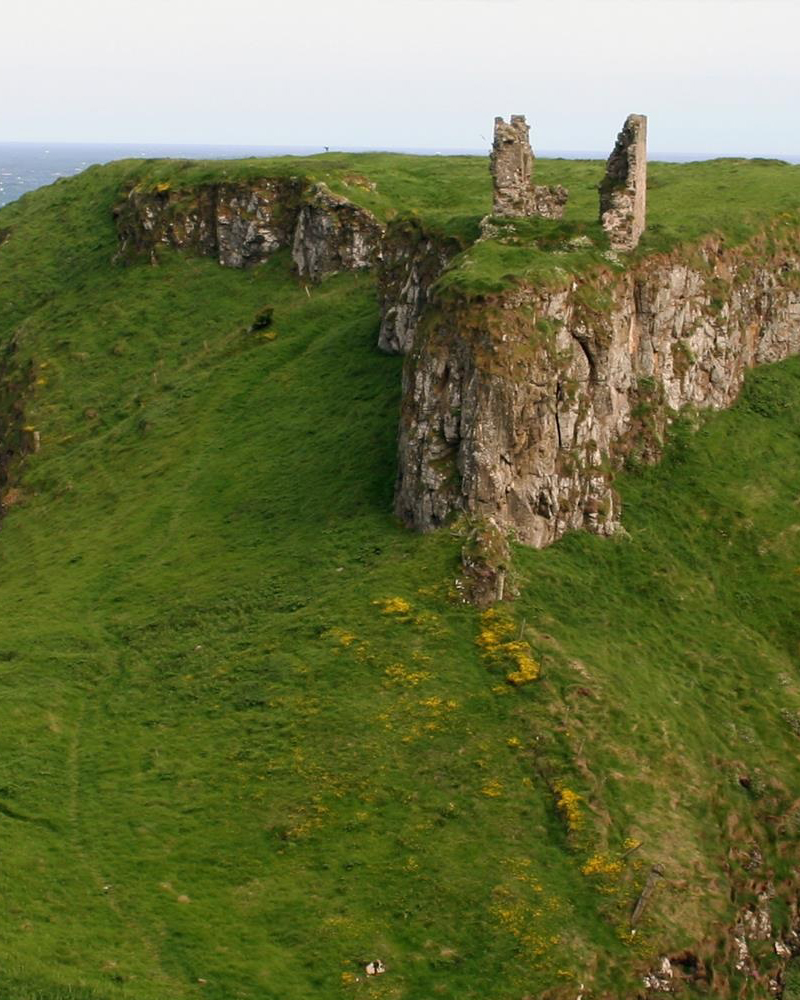
Dunseverick Castle ruins
Tubber Patrick, Portstewart Strand
Hidden near the golden dunes of Portstewart Strand is Tubber Patrick Tobar Phádraig, or “Patrick’s Well.” The well itself predates the saint by millennia, having served as a Stone Age water source long before Christianity reached Ireland. Tradition holds that around 450 AD Patrick blessed the water here, and as Christianity spread across the island, the well became a place of pilgrimage in its own right one of many holy wells regarded as sites of healing and quiet reflection in early Christian Ireland.
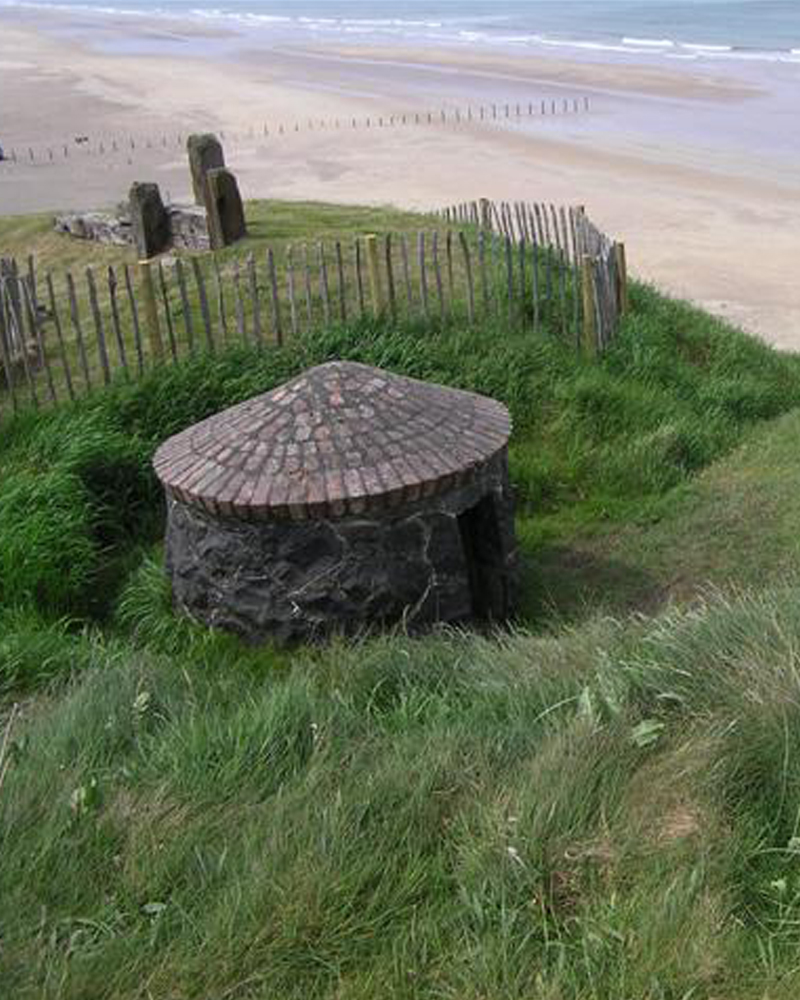
Portstewart Strand / holy well
St Patrick’s Church, Coleraine & Beyond
Coleraine’s name from the Irish Cúil Rathain, meaning “nook of ferns” is also tied to the saint. Patrick is believed to have founded a church here around the 5th century, making it one of Ireland’s earliest Christian settlements. A church has stood on this site, gifted to Patrick by a local chieftain, ever since. Beyond the Causeway Coast, Patrick’s story continues further afield Downpatrick is traditionally regarded as his final resting place and Armagh, the ecclesiastical capital of Ireland, uniquely holds two cathedrals dedicated to him.
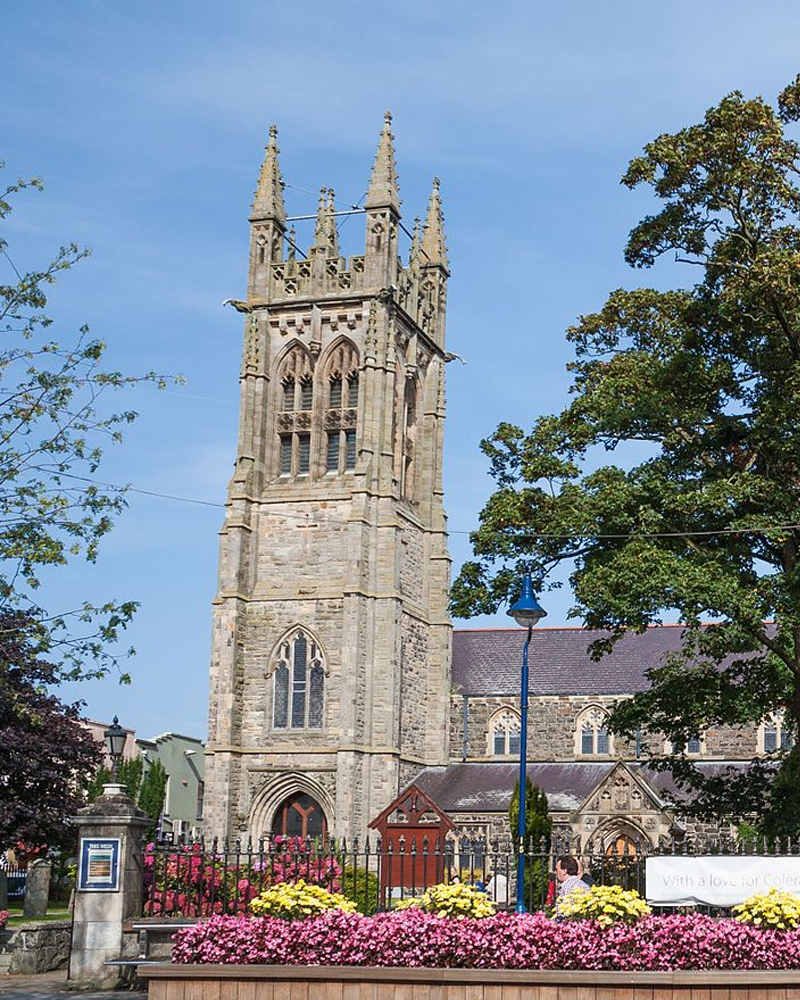
St Patrick’s Church, Coleraine

